When Yura is ten
Maria’s Funeral
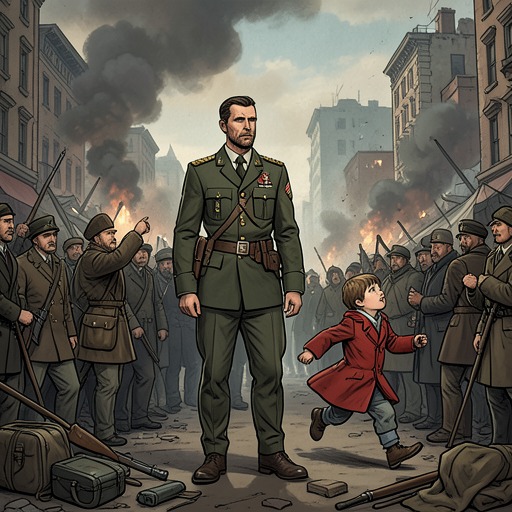
Ten-year-old [Yurii Andreievich Zhivago](entity:character-recall-character-yurii-andreievich-z-e2f255656d66) watches his mother, [Maria Nikolaievna Zhivago](entity:character-recall-character-maria-nikolaievna-z-6ad559538a90), buried in a monastery cemetery. At the grave he breaks down in grief; his uncle, [Nikolai Nikolaievich Vedeniapin](entity:character-recall-character-nikolai-nikolaievic-54fd27e1535f), leads him away from the crowd.
That night, snow and wind erase the landscape outside their lodging. Yura fears that the earth will swallow his mother beyond reach, an early fusion of grief, nature, and the questions of death that will shape his life.
Yura’s early childhood
The Family Fortune Lost
While Maria is alive, Yura does not know that his father, [Andrei Zhivago](entity:character-recall-character-andrei-zhivago-8bb6bf9c2300), has abandoned the family, squandered their wealth, and taken up a dissolute life. He accepts the explanation that his father is away on business.
The Zhivago name once marked factories, banks, buildings, and a grand [Moscow](entity:location-recall-location-19aceb5ce281) estate. Then the wealth disappears, and the family becomes poor, leaving Yura with a remembered world of privilege that no longer exists.
Summer 1903
The Fields and the Land Question
[Nikolai Nikolaievich Vedeniapin](entity:character-recall-character-nikolai-nikolaievic-54fd27e1535f) takes Yura to [Duplyanka](entity:location-recall-location-30776f953f65), where he is revising a book on the land question with the teacher Ivan Ivanovich Voskoboinikov. On the journey, the contrast between the landlord’s fields and the peasants’ land prompts a discussion of unrest and rural injustice.
Their driver, Pavel, distrusts the peasants and argues that they have been treated too well. Yura absorbs the conflict between social hierarchy and ordinary life while the immense landscape awakens his sense of freedom and possibility.
Summer 1903
Nikolai’s Faith in Life
Walking beside Voskoboinikov, [Nikolai Nikolaievich Vedeniapin](entity:character-recall-character-nikolai-nikolaievic-54fd27e1535f) argues that truth is sought by individuals, not by crowds bound to dogma. He describes history as humanity’s long attempt to overcome death and sees Christ’s Gospel as the foundation for love of neighbor, freedom of personality, and sacrifice.
His ideas become central to Yura’s intellectual formation. For him, religion and history are not merely systems of doctrine but ways of understanding the living bond between people and the future.
Summer 1903
Yura’s Prayer in the Gully
Alone in the damp gully at [Duplyanka](entity:location-recall-location-30776f953f65), Yura prays for his dead mother, asking that she be received into heaven and spared suffering. Overcome by grief, he collapses and briefly loses consciousness.
When he wakes, he remembers that he has not prayed for his absent father. Yet the lightness he feels after fainting makes him postpone it. His emotional distance from Andrei is already deeper than the distance created by mere absence.
Summer 1903
The Suicide on the Express
On a train, young [Misha Gordon](entity:character-recall-character-misha-gordon-4493422cfbfa) witnesses the suicide of [Andrei Zhivago](entity:character-recall-character-andrei-zhivago-8bb6bf9c2300), a wealthy and troubled passenger. Andrei has spent days confiding in Misha’s father, Grigory Osipovich Gordon, and speaking anxiously about his family and ruined affairs.
The lawyer [Victor Ippolitovich Komarovsky](entity:character-recall-character-victor-ippolitovich-ac26b83f513a) had accompanied Andrei and repeatedly drawn him away to drink. Misha suspects that the lawyer’s influence helped bring Andrei to destruction, a suspicion that will later connect the Zhivago and Guishar stories.
Summer 1903
Nika’s Childhood Rebellion
At [Duplyanka](entity:location-recall-location-30776f953f65), [Innokentii Dudorov](entity:character-recall-character-innokentii-dudorov-742ff68927bc), called Nika, hides from the visitors and later wanders the grounds, brooding on adulthood, his parents, and his resentment of being treated as a child. In a sudden burst of imagined power, he wills a tree to stop moving and believes it has obeyed.
He and [Nadia Kologrivova](entity:character-recall-character-nadia-kologrivova-ed1743007919) quarrel while picking water lilies, tumble into the pond, and emerge embarrassed by the change in their feelings. Nika discovers that beneath his defiance he longs for another chance to be close to her.
During the Russo-Japanese War, before its end
The Guishars Arrive in Moscow
[Amalia Karlovna Guishar](entity:character-recall-character-amalia-karlovna-gui-d8dfaa6d9e95) arrives in [Moscow](entity:location-recall-location-19aceb5ce281) from the Urals with her children, Rodion and Larisa. On [Victor Ippolitovich Komarovsky](entity:character-recall-character-victor-ippolitovich-ac26b83f513a)’s advice, she takes over a dressmaking workshop and settles with her family in a poor district.
Komarovsky acts as adviser and benefactor while staring at the adolescent [Larisa Feodorovna Guishar](entity:character-recall-character-larisa-feodorovna-g-799d36700271) in a way that makes her blush. The apparent protection he offers the family conceals the danger of his growing interest in her.
Early adolescence
Lara’s Life at the Workshop
[Larisa Feodorovna Guishar](entity:character-recall-character-larisa-feodorovna-g-799d36700271) works, studies, helps her mother, and watches the seamstresses at the family workshop. She admires the quick, unspoiled [Olia Demina](entity:character-recall-character-olia-demina-6f1f2152efd7) and feels the burden of seeing and absorbing too much of the world around her.
Komarovsky’s visits draw the staff’s contempt, and after his bulldog injures Lara, Olia jokes about killing it with poisoned [Easter](entity:time-recall-time-8441fe9013cc) eggs. Lara envies Olia’s practical innocence while sensing that her own life is becoming entangled with forces she cannot control.
When Lara is a little over sixteen
Komarovsky’s Abuse of Lara
Komarovsky seduces Lara, using his age, influence, and financial hold over her mother to keep her near him. His attentions flatter and excite her at first, but shame, exhaustion, and dread increasingly overwhelm her.
Lara understands that she is trapped in a web of dependence and ambiguity: she believes she has power over Komarovsky because he needs her, yet cannot bring herself to expose him. The relationship distorts her sense of love and leaves a lasting wound.
Spring 1906
Lara Finds Shelter
Overwhelmed by her relationship with Komarovsky and afraid that summer will leave her even more exposed to him, Lara asks [Nadia Kologrivova](entity:character-recall-character-nadia-kologrivova-ed1743007919) for help finding work away from her mother. Nadia invites her to become governess to her younger sister, Lipa.
The Kologrivovs welcome Lara into their household. Under their protection she gains several years of safety, completes her education, and begins to rebuild a life on terms she can choose.
During Lara’s years with the Kologrivovs
Rodia’s Gambling Debt
Rodia Guishar confesses that he gambled away money entrusted to him by fellow cadets for a farewell gift. To avoid disgrace, he asks Lara to appeal to Komarovsky, who has made financial assistance conditional on her return to him.
Furious at being treated as an instrument, Lara agrees to obtain the money from the Kologrivovs and demands Rodia’s revolver. The episode exposes how her brother’s irresponsibility can reopen the trap she had struggled to escape.
Christmas 1911
Lara Chooses Pasha
After years of work and increasing restlessness, Lara decides she can no longer remain dependent on the Kologrivovs. She goes to Komarovsky intending to demand money and, if he humiliates or refuses her, to shoot him with Rodia’s revolver.
On the way she stops at [Pavel Pavlovich Antipov](entity:character-recall-character-pavel-pavlovich-ant-9d10e70a3140)’s lodgings and asks him to marry her soon. She does not explain the danger behind her urgency, and Pasha accepts, thrilled to make the future they have long imagined together.
December 27, 1911
The Christmas Party Shooting
At the Sventitskys’ [Christmas](entity:time-recall-time-christmas-a573265d0167) party, Lara arrives armed and searches for Komarovsky. When she finally fires, she wounds the public prosecutor Kornakov instead. The guests seize her, and [Yurii Andreievich Zhivago](entity:character-recall-character-yurii-andreievich-z-e2f255656d66) recognizes her as the girl he once glimpsed in a hotel room.
The shooting is an attempt to break free from Komarovsky, but it exposes Lara to police and public scandal. Her collapse and the confused scene that follows make a deep impression on Yura, who senses the real and destructive force behind the adolescent theories he and his friends once dismissed as vulgarity.
The night of December 27, 1911
Anna Ivanovna Dies
As the [Christmas](entity:time-recall-time-christmas-a573265d0167) party breaks up, Yura and [Tonia](entity:character-recall-character-tonia-0f8665e21496) are summoned home. [Anna Ivanovna Gromeko](entity:character-recall-character-anna-ivanovna-grome-56617c7e8ce6) dies from acute pulmonary edema before they can reach her in time.
Her death draws Yura and Tonia together in a new intimacy. At her funeral, Yura feels that art’s enduring task is to contemplate death while creating life, and he resolves to make a poem from the fragments of experience surrounding the loss.
After the Christmas shooting; before summer 1912
Lara’s Recovery and Marriage
Lara is taken ill with brain fever after the shooting. Komarovsky arranges a room for her, while Kologrivov visits and gives her money to help her become independent. When she recovers, she tries to release Pasha from their engagement, but he refuses to abandon her.
They marry on Whit Monday after finishing their examinations. On their wedding night Lara tells him enough about her past to leave him shaken, yet they set out together for work and a new home in the Urals.
1912, after their marriage
The Antipovs Begin Married Life
Lara and Pasha settle in [Yuriatin](entity:location-recall-location-yuriatin-3442bbcf4e90), where Lara teaches, keeps house, and raises their daughter [Katenka](entity:character-recall-character-katenka-bbd599d2a66d). She is content with the provincial life and its closeness to ordinary people, while Pasha feels intellectually isolated and dissatisfied with his surroundings.
Their marriage is shaped by Pasha’s insecurity and Lara’s instinct to care for him. She loves him, but her devoted, almost maternal solicitude leaves him wondering whether she sees him as a husband or as someone she has undertaken to save.
During the second autumn of World War I
Pasha Enlists
Pasha, troubled by insomnia and convinced that Lara’s love is a heroic duty rather than ordinary desire, decides to enlist. Lara begs him not to leave, but recognizes that he has misread her care as a sign of his own inadequacy.
He goes to military school and then to the front, hoping to distinguish himself and return with honor. Lara is left with [Katenka](entity:character-recall-character-katenka-bbd599d2a66d) and a sense that her brightest hopes have collapsed.
Autumn 1915
Lara Searches for Pasha
When Pasha’s letters stop, Lara makes inquiries and then trains as a nurse. She leaves [Katenka](entity:character-recall-character-katenka-bbd599d2a66d) in [Moscow](entity:location-recall-location-19aceb5ce281) with Lipa and takes a post on a hospital train bound for the front, hoping to discover what happened to her husband.
Her search carries her into the same war that has already separated families and unsettled the moral world. She believes Pasha may be dead, but cannot accept uncertainty as an answer.
Late 1915
Gordon Reaches the Front
[Misha Gordon](entity:character-recall-character-misha-gordon-4493422cfbfa) travels from [Moscow](entity:location-recall-location-19aceb5ce281) to a village near the front, where he finds Yurii Andreievich working as a doctor. The men talk about the war, its brutality, and the difficulty of accepting the logic of mutual destruction.
The nearby villages reveal both the material devastation of the fighting and the vulnerability of civilians caught between armies. Yura’s medical work brings him face to face with violence that cannot be made abstract by political explanations.
Late 1915 or early 1916
Lara and Yura Meet in the Ward
At a mobile [Red Cross](entity:organization-recall-organization-red-cross-cc84ccb88eba) station, Yura and Misha witness a badly wounded soldier die. The nurse is Lara, but none of the three recognizes the full pattern of their connections at first; Lara is still searching for Pasha, and Yura is still married to [Tonia](entity:character-recall-character-tonia-0f8665e21496).
The accidental convergence of these lives gives their later relationship the force of coincidence without resolving its moral complications. Their meeting occurs amid war, illness, and the helpless proximity of people whose histories remain only partly visible to one another.
During the Galician retreat
Yura Defends Jewish Civilians
Yura and Gordon see a Cossack humiliating an elderly Jewish man for sport. Yura intervenes and orders the Cossack to stop, then speaks about the persecution and insecurity endured by Jews in the war zone.
He cannot understand the irrational hatred directed at a vulnerable population already suffering from displacement and violence. The episode brings the novel’s concern with individual dignity into direct conflict with national and political categories.
During the Brusilov offensive
Pasha Is Reported Missing
Pasha leads an attack and disappears after artillery fire breaks up the advance. His comrade [Galiullin](entity:character-recall-character-galiullin-0440f8c66e34) believes he has been killed, though Pasha has in fact been captured by the enemy.
Because the report is uncertain, Lara continues to hope and search. The false belief in his death helps create the new identity Pasha will later adopt as Strelnikov.
February 1917
Yura Is Wounded and Lara Returns
A shell fragment wounds Yura as his medical unit evacuates under German fire. He recovers in hospital and meets Lara again, now serving as a nurse; [Galiullin](entity:character-recall-character-galiullin-0440f8c66e34) tells her that Pasha was taken prisoner rather than killed.
Lara and Yura speak with restraint, each aware of a growing closeness but unwilling to turn it into a claim. News arrives that the Petersburg garrison has joined the insurgents, and the revolution becomes a lived reality rather than an expectation.
February and March 1917
The Revolution Reaches the Front
The old military order collapses, and local officials, soldiers, and medical workers assume improvised roles. Yura, Lara, and [Galiullin](entity:character-recall-character-galiullin-0440f8c66e34) participate in temporary administration but increasingly feel the need to return to ordinary work and family life.
Yura writes to [Tonia](entity:character-recall-character-tonia-0f8665e21496) about Lara and tells her that he intends to come home. Tonia’s reply, however, urges him to go directly to the Urals with Lara, a painful misreading of his situation that makes him realize how ambiguous his conduct has become.
Summer 1917
Gints Tries to Appease the Deserters
In [Meliuzeievo](entity:location-recall-location-meliuzeievo-4e9cd906a633), [Commissar Gints](entity:character-recall-character-commissar-gints-b5557ae10f6c) rejects a plan to use Cossacks against deserters and instead insists that he can persuade them by appealing to their ideals. The doctor recognizes the naïveté of his rhetoric but also the cynical opportunism of the local command.
At a public meeting, Gints lectures the crowd about duty and discipline. [Ustinia](entity:character-recall-character-ustinia-e13f68922f19) challenges him with a folk-religious argument, exposing the gulf between political phrases and the people’s lived beliefs.
Summer 1917
The Zybushino Republic
The miller [Blazheiko](entity:character-recall-character-blazheiko-d1198694037b) and armed deserters establish a short-lived republic at [Zybushino](entity:location-recall-location-zybushino-ad14228d1d53), rejecting the [Provisional Government](entity:organization-recall-organization-provisional-gove-c2a103b6ea73) and proclaiming a communal, millennial order. Government forces end the experiment after two weeks.
The episode makes the revolution’s competing visions tangible: local autonomy and religious idealism collide with state power and political organization. Its aftermath feeds rumor, repression, and further disorder across the region.
After the fall of the Zybushino Republic
The Soldiers Kill Gints
Gints travels to the [Biriuchi](entity:location-recall-location-biriuchi-70432e0766fe) area to address a body of deserters. His speech turns from appeal to threats, and the troops, already hostile to his authority, reject him. He attempts to address them from a water butt near the station but slips and is shot, then bayoneted.
The death is both absurd and brutal: the man who trusted persuasion becomes a victim of the very armed disorder he hoped words could settle. The episode marks the shrinking space for humane political action.
Late 1917
Yura Returns to Moscow
After leaving [Meliuzeievo](entity:location-recall-location-meliuzeievo-4e9cd906a633), Yura travels north through a country crowded with refugees and disrupted trains. A strange deaf-mute passenger, [Maxim Aristarkhovich Klintsov-Pogorevshikh](entity:character-recall-character-maxim-aristarkhovic-322dfaa18bd7), tells him of the [Zybushino](entity:location-recall-location-zybushino-ad14228d1d53) revolt and argues that social disintegration must deepen before a new order can be built.
As [Moscow](entity:location-recall-location-19aceb5ce281) comes into view, Yura feels that home and family are the real goal of his wandering. He reaches the [Gromeko house](entity:location-recall-location-c34650f2a653) and is reunited with [Tonia](entity:character-recall-character-tonia-0f8665e21496), their son Sasha, and [Alexander Alexandrovich Gromeko](entity:character-recall-character-alexander-alexandro-16c75b3bc76b).
Late 1917, after returning to Moscow
Yura Meets His Son
Yura meets Sasha, whom he has scarcely known since being mobilized after the child’s birth. The boy reacts to the unfamiliar, unshaven father by slapping him and then fleeing into [Tonia](entity:character-recall-character-tonia-0f8665e21496)’s arms.
The encounter leaves Yura depressed and uneasy. He wants to belong to his family, yet the war and separation have made even fatherhood feel like a gift from which he has been excluded.
Late 1917
A Housewarming in Scarcity
The Yagoda family held a small gathering. A companion that Yura met on the train brought a duck, and Gordon brought wine. In hungry [Moscow](entity:location-recall-location-19aceb5ce281), the meal was more a betrayal than a celebration of those who had nothing. Yura realized that when personal happiness is entirely different from the lives
Autumn 1917
Yura Welcomes the Bolshevik Decrees
At a street corner, Yura reads the announcement that Soviet power has been established. He is moved by the audacity of a revolution that begins in the middle of ordinary life rather than waiting for a clean historical beginning.
He praises its uncompromising attack on injustice, even as the hardships around him intensify. His early enthusiasm will later be tested by the gap between revolutionary promises and the coercive institutions built in their name.
October 1917
The Moscow Fighting
Street fighting breaks out between cadets loyal to the [Provisional Government](entity:organization-recall-organization-provisional-gove-c2a103b6ea73) and soldiers supporting the [Bolsheviks](entity:organization-recall-organization-bolsheviks-44ca07d34068). Yura’s family is confined at home while Sasha falls ill, and the household struggles to find medicine and supplies amid gunfire.
The fighting makes the political upheaval intimate: the city’s future is decided outside while a child’s breathing becomes the family’s immediate crisis. After the Bolshevik side prevails, Yura attempts to resume hospital work.
Winter 1917–1918
Yura’s Work and Moscow’s Hunger
Yura returns to the hospital, where staff are divided by politics and daily work is burdened by shortages of food, fuel, and medicine. He remains at his post while others leave, and his private notes record the strain of watching people act parts imposed by the age.
The family trades belongings for firewood and food. Their survival depends on labor and improvisation rather than on the grand schemes announced by the new authorities.
Winter 1917–1918
The Typhus Patient
A summons takes Yura to a crowded tenement, where he diagnoses a woman with severe typhus and orders her transferred to hospital. In the basement meeting of tenants, he meets Galiullina, the mother of his wartime acquaintance [Galiullin](entity:character-recall-character-galiullin-0440f8c66e34), and learns that her son has entered the White camp.
[Olia Demina](entity:character-recall-character-olia-demina-6f1f2152efd7), now a borough delegate, helps arrange transport for the patient. The encounter brings the doctor back into the working-class world of the Brest Street tenement and reveals how revolution has rearranged old relationships without erasing their past.
Winter 1917–1918
Yura Falls Ill
After collapsing on the way home with a load of wood, Yura develops typhus and lies delirious for weeks. In fever dreams he writes a poem about the days between burial and resurrection, while a boy in a reindeer coat appears as both a helper and an image of death.
[Tonia](entity:character-recall-character-tonia-0f8665e21496) nurses him with rare food and drink supplied by his half-brother Evgraf, who visits repeatedly and then disappears. On recovery, Yura learns that Evgraf is his brother and that he has proposed moving the family to [Varykino](entity:location-recall-location-varykino-0f60e2ea7bf5).
Spring 1918
The Journey to the Urals
The Zhivagos leave [Moscow](entity:location-recall-location-19aceb5ce281) for the Urals, carrying belongings that can serve as currency. At the station, the crowds, recently ill travelers, and corrupt demands for favors make clear how precarious travel has become.
On the way, the family shares a freight car with labor conscripts, including [Vasia Brykin](entity:character-recall-character-vasia-brykin-9042c373c806), Prituliev, and their guard. The journey is a flight from hunger and political danger, but it also immerses Yura in the human consequences of state compulsion.
Spring 1918, during the journey east
The Conscripts’ Escape
During the train journey, the labor conscripts [Vasia Brykin](entity:character-recall-character-vasia-brykin-9042c373c806), Prituliev, and the two rival women, Tiagunova and [Ogryzkova](entity:character-recall-character-ogryzkova-246a1575aac4), escape. Their guard Voroniuk vanishes as well, leaving the convoy’s officers furious and confused.
The train continues through a flooded landscape. Yura sees the escape not as a crime but as a release, like water breaking free, and the episode briefly offers a human image of freedom amid the coercion of war and revolution.
Spring 1918, near Ust-Nemdinsk
The Railway Is Cleared
The train stops at a burned station blocked by deep snow, and the passengers and conscripts are ordered to clear the railway. The Zhivagos take part in three days of exhausting work alongside strangers from many walks of life.
The shared labor restores the line and creates a temporary community outside the usual political divisions. For Yura, the clean snow, bread, and physical effort recall childhood and offer a rare interval in which work feels direct and meaningful.
Spring 1918
The Zhivagos Reach Torfianaia
After further delays and frightening encounters, the family reaches Torfianaia, where a stationmaster recognizes Antonina as Krueger’s granddaughter and arranges a cart to [Varykino](entity:location-recall-location-varykino-0f60e2ea7bf5). Their driver, [Bacchus Mekhonoshin](entity:character-recall-character-bacchus-mekhonoshin-6b43c40f4228), tells them that the legendary blacksmith called Bacchus is not himself but another man of the same name.
The journey through the Urals ends with a warm welcome to a quiet, wooded station and a ride across the countryside. Their arrival feels like a return to a world outside the capitals’ constant violence, though the estate itself is far from secure.
Spring 1918
The Mikulitsyns Accept Them
At [Varykino](entity:location-recall-location-varykino-0f60e2ea7bf5), [Averkii Stepanovich Mikulitsyn](entity:character-recall-character-averkii-stepanovich-fa268a8d012f) and Elena Proklovna initially resist the arrival of Krueger’s relatives. They fear the political danger of sheltering the family and resent being asked to take responsibility for them.
Mikulitsyn relents and gives them space in an annex. The family begins repairing it and planning a garden, while the divide between the revolutionary Mikulitsyns and their son [Liberius](entity:character-recall-character-liberius-e056d52055d8) hints at the conflicts surrounding the estate.
Summer and autumn 1918
A Life Built by Hand
The family repairs the annex, plants vegetables, stores potatoes and preserves, and cuts wood. Yura also treats local people, though he officially claims to have given up medicine. [Anfim Efimovich Samdeviatov](entity:character-recall-character-anfim-efimovich-sam-f1b72f968ca7) supplies provisions and quietly supports both the Zhivagos and the Mikulitsyns.
Yura’s diary reflects on physical labor, art, motherhood, and the organic renewal of life. When Evgraf appears unexpectedly, he once again helps the family and then vanishes, deepening the mystery of his influence.
After arriving in Varykino, during the first year there
Yura Meets Lara in Yuriatin
Yura begins visiting the [Yuriatin Public Library](entity:organization-recall-organization-21df1117c055) and sees Lara, now living in town with [Katenka](entity:character-recall-character-katenka-bbd599d2a66d). He hesitates to approach her, then learns the address on her library slips and visits her home, where she is carrying water from the well.
Their meeting rekindles their connection. Lara speaks about the violence in [Yuriatin](entity:location-recall-location-yuriatin-3442bbcf4e90), the White occupation, and her efforts to protect others, while Yura explains his disillusionment with revolutionaries who treat perpetual upheaval as a purpose in itself.
During Yura’s first year at Varykino
Lara Reveals Strelnikov’s Identity
Lara tells Yura that Strelnikov is her husband, Pasha, whom she had believed dead and later sought at the front. She describes his transformation into a revolutionary commander and his deliberate refusal to visit her or their daughter while serving the cause.
She has seen him from a distance and believes his absolute devotion to revolutionary work has turned him into an instrument of an impersonal force. Her story makes clear that the private lives of Lara and Pasha have been subordinated to a political identity that neither can easily escape.
Two months after their renewed meeting
Yura’s Affair with Lara
Yura’s relationship with Lara becomes an affair, and he returns to [Varykino](entity:location-recall-location-varykino-0f60e2ea7bf5) burdened by guilt toward [Tonia](entity:character-recall-character-tonia-0f8665e21496). He decides to confess and end the relationship, but on the journey home he persuades himself that the confession can wait until another visit.
His desire to see Lara again defeats his resolution. The choice reveals the divided loyalties that will govern his life: he loves Tonia and Lara, but his inability to choose honestly deepens the pain of all three.
During the Russian Civil War, after the affair begins
Yura Is Captured by Partisans
On a ride back from [Yuriatin](entity:location-recall-location-yuriatin-3442bbcf4e90), Yura is stopped at a forest crossroads by armed men from the [Forest Brotherhood](entity:organization-recall-organization-07458fc4daa8). Their medical officer has been killed, and they forcibly conscript him into the partisan force led by [Liberius Averkievich Mikulitsyn](entity:character-recall-character-liberius-averkievic-cb9378627e23).
The capture separates Yura from both his [Moscow](entity:location-recall-location-19aceb5ce281) family and Lara. Though the partisans do not imprison him behind walls, their constant movement and control make his captivity real, and his repeated escape attempts fail.
During the Civil War, before Yura’s long captivity
The Kuteiny Draft Uprising
At a recruitment examination in [Maly Ermolaï](entity:location-recall-location-maly-ermola-6ae6bb4242e6), [Sanka Pafnutkin](entity:character-recall-character-sanka-pafnutkin-daf8e0279764) refuses to undress, overturns a table, and flees. The disturbance becomes entangled with a separate explosion and a search by [Colonel Strese](entity:character-recall-character-colonel-strese-d603ed42ebf9)’s men for suspected political rebels.
[Terentii Galuzin](entity:character-recall-character-terentii-galuzin-fe2b6333714c) and other young men hide beneath a barn floor, then decide that the forest is their only refuge. Their flight from arbitrary suspicion foreshadows the shifting allegiances and violence that will later engulf the partisan camp.
During his first year with the partisans
Yura Saves a White Soldier
Caught in a battle, Yura takes a dead telephonist’s rifle and fires at a tree rather than deliberately shoot the young White volunteers he sympathizes with. Even so, he wounds two men and appears to kill Seriozha Rantsevich.
Seriozha survives because his mother’s amulet stops the bullet. Yura secretly exchanges the dead telephonist’s clothes for the young man’s and helps him recover, then lets him go despite knowing he intends to return to the White army.
During the partisan winter preparations
A Plot Against Liberius
Yura overhears a conspiracy to betray or kill [Liberius](entity:character-recall-character-liberius-e056d52055d8), involving partisans willing to collaborate with the enemy. He tries to warn the command, but the plot is already known and [Sivobluy](entity:character-recall-character-sivobluy-c399c9168205) has been acting as an informer.
The conspirators are seized. Yura feels no satisfaction: the failed plot confirms the camp’s atmosphere of mistrust and shows how loyalty, surveillance, and political survival have become inseparable.
A cold morning during the partisan winter
The Conspirators Are Executed
Eleven alleged ringleaders and two men accused of brewing vodka are driven to a rocky precipice near the camp. One condemned man fires at the guards, and panic and pleading spread through the group before a volley kills them.
The execution, carried out near a solitary rowan tree, reveals the [Forest Brotherhood](entity:organization-recall-organization-07458fc4daa8)’s transformation from a popular army into a force capable of reproducing the terror it claims to oppose. [Terentii Galuzin](entity:character-recall-character-terentii-galuzin-fe2b6333714c) appears to die in the shooting, though he survives.
During the partisan encirclement
The Refugees Cross the Taiga
After a partisan sortie breaks through the White lines, frightened villagers flood toward the taiga. The command tries to redirect them to [Dvory](entity:location-recall-location-4e065849985c), but the village has been burned and the women instead cut roads and bridges through the forest to reach the camp.
Their resourcefulness disrupts [Liberius](entity:character-recall-character-liberius-e056d52055d8)’s plans, while the scale of their flight exposes the civilian cost of the war. Some women break under hunger and fear; others show endurance that surpasses that of the soldiers.
During the partisan encirclement, after the refugees arrive
Pamphil Kills His Family
[Pamphil Palykh](entity:character-recall-character-pamphil-palykh-c98117cf4180) hears an atrocity victim describe torture by the [Whites](entity:organization-recall-organization-4d8b856bc7be) and imagines the same fate awaiting his wife and children. Overwhelmed by fear, he kills them with the ax he had used to carve toys for them.
He then wanders the camp in a state of profound mental collapse and eventually disappears into the forest. His act is a devastating consequence of a war in which terror and anticipation of violence destroy the very people a soldier hopes to protect.
The winter after the partisan family convoy arrives
Yura Escapes the Partisans
Hearing rumors that [Varykino](entity:location-recall-location-varykino-0f60e2ea7bf5) is deserted and remembering the threat to his family, Yura decides to escape. He slips past the sentries and retrieves skis and supplies he had hidden outside the camp.
At the rowan tree he promises himself that he will find Lara, then sets out alone through the taiga. The escape ends his long captivity but leaves him exhausted, hungry, and ignorant of the fate of everyone he loves.
Near the end of the Civil War
Yura Reaches Yuriatin
After a dangerous trek through abandoned trains, disease, hunger, and violence, Yura reaches [Yuriatin](entity:location-recall-location-yuriatin-3442bbcf4e90). At Lara’s building he finds a key and a note left for him, saying that she has gone to [Varykino](entity:location-recall-location-varykino-0f60e2ea7bf5) with [Katenka](entity:character-recall-character-katenka-bbd599d2a66d) but expects him to arrive.
A second message reveals that [Tonia](entity:character-recall-character-tonia-0f8665e21496) and the family are in [Moscow](entity:location-recall-location-19aceb5ce281) and that Tonia has given birth to a daughter, Masha. Yura’s relief is mixed with anguish: Lara has not told him where his family is, and he has no clear way to reach them.
After his return to Yuriatin
Yura Works in Yuriatin
Weak and nearly starving, Yura collapses while reading the new authorities’ proclamations. He enters Lara’s empty flat and fortifies a room against rats, then visits a tailor’s workshop for a haircut and shave.
The stern seamstress Glafira Tuntseva tells him that Lara and [Katenka](entity:character-recall-character-katenka-bbd599d2a66d) have left [Varykino](entity:location-recall-location-varykino-0f60e2ea7bf5) and that [Tonia](entity:character-recall-character-tonia-0f8665e21496)’s family passed through [Yuriatin](entity:location-recall-location-yuriatin-3442bbcf4e90) on their way to [Moscow](entity:location-recall-location-19aceb5ce281). The news confirms that his family has returned to [Russia](entity:location-recall-location-e36341713c23), but he remains stranded and increasingly ill.
After reaching Yuriatin
Yura Recovers with Lara
Yura falls seriously ill in Lara’s flat, overwhelmed by hunger, exhaustion, and grief. Lara returns and nurses him, and the two are reunited in a period of tenderness that neither can pretend is ordinary or secure.
They discuss Komarovsky, Pasha, and the failures of the revolution. Lara says she will not leave for the [Far East](entity:location-recall-location-94f797a2c630) without Yura, even as she recognizes that their love stands in tension with their obligations to their spouses and children.
During Yura’s stay with Lara in Yuriatin
Tonia’s Letter Arrives
A long-delayed letter from [Tonia](entity:character-recall-character-tonia-0f8665e21496) reaches Yura through Glafira. Tonia writes that she and her father, Sasha, and baby Masha are being deported abroad with other intellectuals and political figures; she believes Yura is alive but fears they may never meet again.
She also thanks Lara for helping her through childbirth and confesses her own love and pain. Yura is overwhelmed by the letter and collapses, faced at last with the human cost of his prolonged absence.
Winter, after Tonia’s letter arrives
Komarovsky Offers Escape
Komarovsky visits Lara and Yura in [Yuriatin](entity:location-recall-location-yuriatin-3442bbcf4e90) and warns that both are in danger of arrest. He offers to take Lara and [Katenka](entity:character-recall-character-katenka-bbd599d2a66d) east with him, where a proposed Far Eastern government may provide a route abroad, and says he will also try to save Strelnikov.
Yura distrusts Komarovsky’s promises and refuses to let him manage his life. Lara is torn between fear for her daughter and her unwillingness to leave Yura, so the offer remains unresolved.
Winter, after Komarovsky’s first visit
Yura and Lara Choose Varykino
With arrests spreading through [Yuriatin](entity:location-recall-location-yuriatin-3442bbcf4e90), Lara and Yura decide to withdraw to [Varykino](entity:location-recall-location-varykino-0f60e2ea7bf5). They intend to hide for a time, though neither knows how they will obtain food or whether the isolated estate is safe.
Their decision is less a confident plan than a choice to spend whatever time remains together. Yura urges Lara to consider Komarovsky’s offer, but she will not go without him.
Winter, after leaving Yuriatin
The Zhivagos Return to Varykino
Yura, Lara, and [Katenka](entity:character-recall-character-katenka-bbd599d2a66d) travel to [Varykino](entity:location-recall-location-varykino-0f60e2ea7bf5) in a sleigh borrowed through Samdeviatov. They first enter the Zhivago house, where the sight of the family’s abandoned nursery and Sasha’s crib nearly overwhelms Yura, then settle in the Mikulitsyns’ house.
They find parts of the estate unexpectedly tidy, suggesting that someone has used it recently. The mystery does not deter them; they begin making rooms habitable and try to create a temporary home amid the ruins of their former lives.
The first nights of their stay
Yura Writes at Varykino
While Lara and [Katenka](entity:character-recall-character-katenka-bbd599d2a66d) establish a domestic routine, Yura begins writing by lamplight. He copies remembered poems, drafts new work, and feels language itself carrying him into creation.
For a brief interval, the clean rooms, sleeping child, moonlit snow, and Lara’s presence join into a vision of life as a gift. His writing becomes both an artistic act and a way of making meaning from the separation and danger surrounding them.
Several nights into their Varykino stay
Wolves Circle the House
Yura hears wolves howling near the house and worries that they may attack Samdeviatov’s horse. Lara hears the same sounds and takes them as an omen, becoming increasingly anxious about remaining in the isolated estate.
Their days alternate between practical work, affection, and arguments about whether to leave. The wolves become an emblem of the hostile forces closing in on their fragile refuge.
About two weeks after their arrival at Varykino
Komarovsky Returns with Urgent News
Komarovsky unexpectedly appears at [Varykino](entity:location-recall-location-varykino-0f60e2ea7bf5) with a sleigh and driver. He says that Strelnikov has been captured and shot and argues that Lara and [Katenka](entity:character-recall-character-katenka-bbd599d2a66d) are now in immediate danger.
He presses Yura to let them travel east with him on a government train. Yura resists at first, but the news of Pasha’s death and the danger to Lara and her child force him to reconsider what their separation might mean.
The day Komarovsky returns to Varykino
Yura Lets Lara Go
Komarovsky privately tells Yura that Lara and [Katenka](entity:character-recall-character-katenka-bbd599d2a66d) need to escape and asks him to pretend that he may follow later. Yura agrees to let them go, telling himself that their safety matters more than his pride, though he cannot bear the deception.
Lara leaves believing Yura will catch up with them. He watches her sleigh disappear and grieves, then returns to the empty house, where he weeps and begins writing his farewell to her.
Days after Lara’s departure
Yura Meets Strelnikov Again
Strelnikov arrives at the empty [Varykino](entity:location-recall-location-varykino-0f60e2ea7bf5) house, hiding from arrest and searching for Lara and their daughter. He and Yura talk through the night about the revolution, their pasts, and their love for Lara.
Yura tells him that Lara had spoken of Pasha as the embodiment of what a human being should be. Strelnikov is shaken by the knowledge that she still loved him and had wanted to return to their shared home.
The morning after his reunion with Yura
Strelnikov’s Suicide
Yura wakes after a rare night of deep sleep and discovers that Strelnikov has left the room. Outside, he finds him dead in the snow from a self-inflicted gunshot wound.
The man who devoted his life to restoring justice and winning freedom for his family dies alone, unable to rejoin either the private life he sacrificed or the political world that has turned against him.
After Strelnikov’s death
Varykino Is Destroyed
The narrative later reveals that [Varykino](entity:location-recall-location-varykino-0f60e2ea7bf5) was raided by armed strangers who killed those they found and left the settlement in ruins. The Zhivago family had escaped before the attack, but Yura had remained behind and was presumed dead.
The destruction severs the last link between his brief retreat and the family he hoped to protect. It also leaves the survivors scattered across a landscape where official records and reliable communication have largely disappeared.
After the Civil War, before the beginning of NEP
Yura Walks Back to Russia
Yura makes the final leg of his return to [Moscow](entity:location-recall-location-19aceb5ce281) on foot, crossing devastated villages and abandoned fields. Mice, feral dogs, hunger, and ruined settlements mark a country where ordinary life has collapsed.
He reaches the burned remains of [Vasia Brykin](entity:character-recall-character-vasia-brykin-9042c373c806)’s village and recognizes the boy from the labor train. [Vasia](entity:character-recall-character-vasia-1ce967fca722) tells him that his mother is dead and his sisters are missing, then joins him on the journey to Moscow.
Spring 1922
Yura and Vasia Rebuild Their Lives
In [Moscow](entity:location-recall-location-19aceb5ce281), Yura helps [Vasia](entity:character-recall-character-vasia-1ce967fca722) enter the [Stroganov Institute](entity:organization-recall-organization-250fcd7be996), where the young man studies printing and book design. Together they produce small editions of Yura’s essays, medical reflections, stories, and poems.
Yura also tries to obtain permission for his family to return from [Paris](entity:location-recall-location-paris-c02b439ce220) and to secure travel documents of his own. His writings circulate among collectors, but the effort to recover a shared family life remains uncertain.
During NEP, after his return to Moscow
Yura Becomes Marina’s Partner
Yura moves into a poor corner of the former [Sventitsky house](entity:location-recall-location-793140fafd60), where [Markel Shchapov](entity:character-recall-character-markel-shchapov-9d66eb70f27f) and his family live. A friendship grows between Yura and Markel’s daughter [Marina](entity:character-recall-character-marina-634ff8f0a512), who helps him with his chores and later becomes his third partner; they have children together without registering a marriage.
Yura remains legally married to [Tonia](entity:character-recall-character-tonia-0f8665e21496), whose family is abroad. His life grows increasingly disordered, but Marina is devoted to him and accepts his eccentricities and periods of withdrawal.
Summer 1929
Yura’s Friends Confront Him
At [Misha Gordon](entity:character-recall-character-misha-gordon-4493422cfbfa)’s room, Gordon and [Innokentii Dudorov](entity:character-recall-character-innokentii-dudorov-742ff68927bc) urge Yura to resume his medical work and clarify his relationships with [Tonia](entity:character-recall-character-tonia-0f8665e21496) and [Marina](entity:character-recall-character-marina-634ff8f0a512). Dudorov speaks approvingly of his political re-education in prison, while Yura sees such conformity as a denial of private judgment.
Yura explains that sustained dishonesty and the forced suppression of one’s convictions can damage the body as well as the soul. He promises that he wants to change, but the promise comes during a period of serious heart disease and exhaustion.
Late summer 1929
Yura Disappears into Hiding
After leaving Gordon’s room, Yura encounters Evgraf, who has returned to [Moscow](entity:location-recall-location-19aceb5ce281) without warning. Evgraf quickly understands his brother’s precarious position and arranges a room, money, and the prospect of a hospital post.
He advises Yura to disappear for a time while he works to resolve the family’s situation. Yura’s friends and [Marina](entity:character-recall-character-marina-634ff8f0a512) search for him, but letters from Yura ask them to stop and promise that he will return once he is settled.
During his final months
Yura Writes About Moscow
In a room near the [Moscow Art Theatre](entity:organization-recall-organization-285e1301dcf5), Yura writes essays and poems inspired by the city. He sees the modern city as the source of a new art whose crowded impressions and restless movement reflect contemporary life.
His papers preserve an unfinished body of work, written in bursts of creative intensity while the promised hospital appointment remains delayed. The city becomes the final landscape through which he tries to understand his own life.
Late August 1929
Yura Dies on the Trolley
On his way to begin work at the [Botkin Hospital](entity:location-recall-location-botkin-hospital-da221454640f), Yura rides a crowded trolley that repeatedly breaks down in the heat. He sees an elderly woman passing the stalled car and feels nausea and weakness, but struggles on toward the rear platform for air.
He collapses in the street and dies of heart failure. The woman, [Mademoiselle Fleury](entity:character-recall-character-mademoiselle-fleury-2e0f33119d16), is on her way to collect an exit visa and does not realize that she has outlived him.
Immediately after Yura’s death
Lara Returns for the Funeral
Yura’s friends and [Marina](entity:character-recall-character-marina-634ff8f0a512) gather around his body, and Evgraf takes charge of the cremation arrangements. Lara arrives in [Moscow](entity:location-recall-location-19aceb5ce281) by chance while searching for the house where Pasha once lived; she enters the room and discovers Yura in the coffin.
She learns from Evgraf that Pasha shot himself in the same house after she left [Varykino](entity:location-recall-location-varykino-0f60e2ea7bf5). The revelation that Yura and Pasha met before their deaths brings her a moment of gratitude amid grief, and she agrees to help sort Yura’s papers.
Days after Yura’s cremation
Lara Disappears
Lara stays in [Kamerger Street](entity:location-recall-location-kamerger-street-fde3e976236b) to help Evgraf sort Yura’s manuscripts. She speaks of needing to find a child who was separated from its mother and asks for advice about locating children’s homes and records.
One day she goes out and does not return. She is believed to have been arrested and to have died anonymously in one of the northern camps, leaving her daughter’s fate unresolved.
Summer 1943, after the Battle of Kursk
Gordon and Dudorov in Wartime
During the Second World War, Gordon and Major Dudorov meet while returning to their unit after the liberation of [Orel](entity:location-recall-location-orel-9be675010daf). They spend a night in a ruined town, discussing [Christina Orletsova](entity:character-recall-character-christina-orletsova-92ff82fff0e5), Dudorov’s former fiancée, whose courage and death have become known across the region.
Their conversation turns to the political terror of the 1930s and to the war as a release from the lie that had governed public life. The friends see Christina’s sacrifice as part of a generation’s moral ordeal.
Autumn 1943
Christina’s Story Emerges
[Tania Bezocheredeva](entity:character-recall-character-tania-bezocheredeva-476bd7e8e392) tells Gordon and Dudorov how she was separated from her mother as a child and raised by a railway signal family. After a robbery and murder at the signal house, she escaped aboard a passing train and drifted among homeless children.
Her story reveals that she is the daughter Lara had been trying to trace, though Tania does not know her parentage. Evgraf has already met her and promised to help, connecting the lost child’s future to Yura’s surviving family.
Five or ten years after the war
The Friends Read Yura’s Work
Gordon and Dudorov sit above [Moscow](entity:location-recall-location-19aceb5ce281) and read the collected writings Evgraf has assembled from Yura’s papers. The city below them appears not merely as the setting of his life but as the central protagonist of the story they have finished reading.
Though victory has not brought the freedom they expected, the friends sense portents of a freer future. Yura’s work, and the survival of those who loved him, sustains their hope and closes the novel on a vision of continuity beyond loss.